In 2023, almost everyone thought agent memory was mostly a context-window problem.
The context windows were small. The models were stateless. If you wanted an agent to remember anything, you had to stuff the right text into the prompt, retrieve some old conversation, summarize a transcript, or build a clever wrapper around the model. Memory felt like context management with better branding.
That was not wrong. But it was incomplete.
Over the last few years, “memory” has quietly changed meaning. It started as a workaround for forgetting. Then it became a way to make agents believable. Then it became a benchmark. Then a product category. Then a battleground. And now, in 2026, it is becoming something closer to the question underneath all agentic AI:
Can an AI system accumulate experience without corrupting itself?
2023: The Village, the OS, and the Cognitive Map
 Generative Agents
The first paper that made agent memory feel real to many people was Generative Agents.
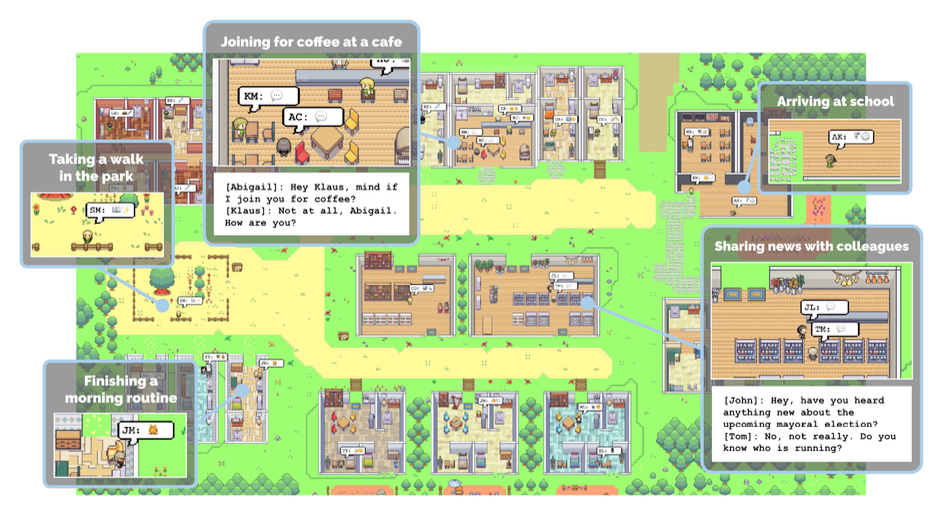
It gave us Smallville: a tiny simulated town populated by 25 agents who woke up, cooked breakfast, went to work, talked to one another, formed opinions, remembered events, and even organized a Valentine’s Day party. The magic was not that the underlying language model had changed. It had not. The magic was the architecture around it.
Each agent had a memory stream: a natural-language log of observations and experiences. Memories were retrieved by relevance, recency, and importance. The agent also reflected on those raw memories, turning scattered observations into higher-level beliefs. This sounds simple now, but it became one of the core templates for the entire field: observe, store, retrieve, reflect, plan.
 LLM Finite Context Window (MemGPT)
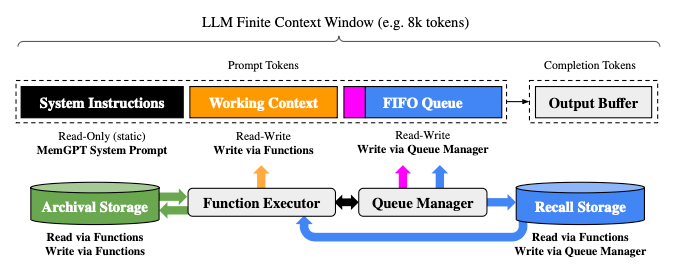
Around the same time, MemGPT gave us a different metaphor: the LLM as an operating system. If the context window is fast but tiny memory, then the external store is slow but large memory. The model becomes its own memory manager, paging information in and out through function calls.
That framing stuck. Even when later systems stopped literally paging context like an OS, the intuition survived: memory is not just more text. It is lifecycle management. What stays active? What gets evicted? What gets summarized? What gets persisted?
 Categorization of human memory (Lil’Log)
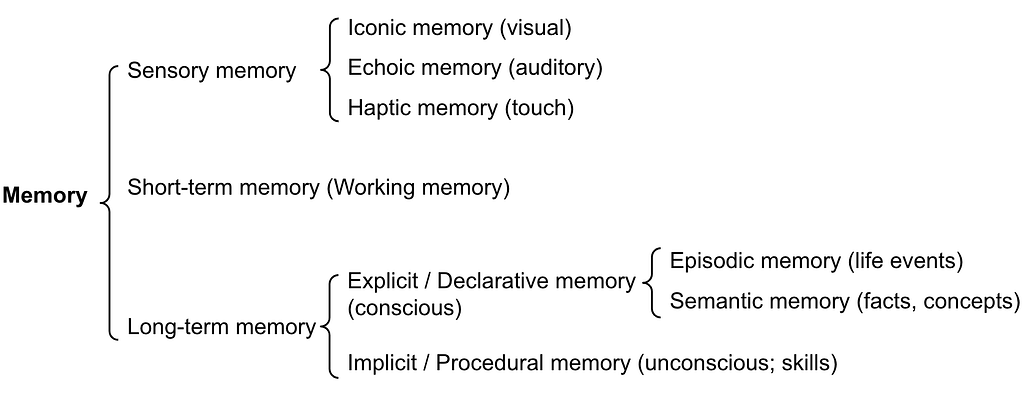
Then CoALA gave the field a cognitive map. It organized language agents around working memory, episodic memory, semantic memory, and procedural memory. CoALA also sits directly in the lineage of Lilian Weng’s hugely influential “LLM Powered Autonomous Agents” post; in fact, that post is the first reference cited in the paper. For many builders, that blog post shaped the early vocabulary of agents: memory, planning, tool use, reflection.
Looking back, 2023 was the year of invention by analogy. Researchers borrowed from cognitive science, operating systems, databases, and human forgetting. The systems were mostly training-free and wrapped around frozen models. The field had a hunch: if the model could remember, reflect, and retrieve, maybe it could start behaving like an agent.
But there was a problem.
Nobody really knew how to measure whether a memory was good.
There were demonstrations, ablations, custom evaluations, and early datasets. But there was no shared yardstick. Temporality was still a minority concern. Papers like MemoryBank and SCM were already being pulled toward AI-companion and personalization use cases, but the broader field had not yet agreed what “good long-term memory” meant.
2024: Memory Becomes Measurable
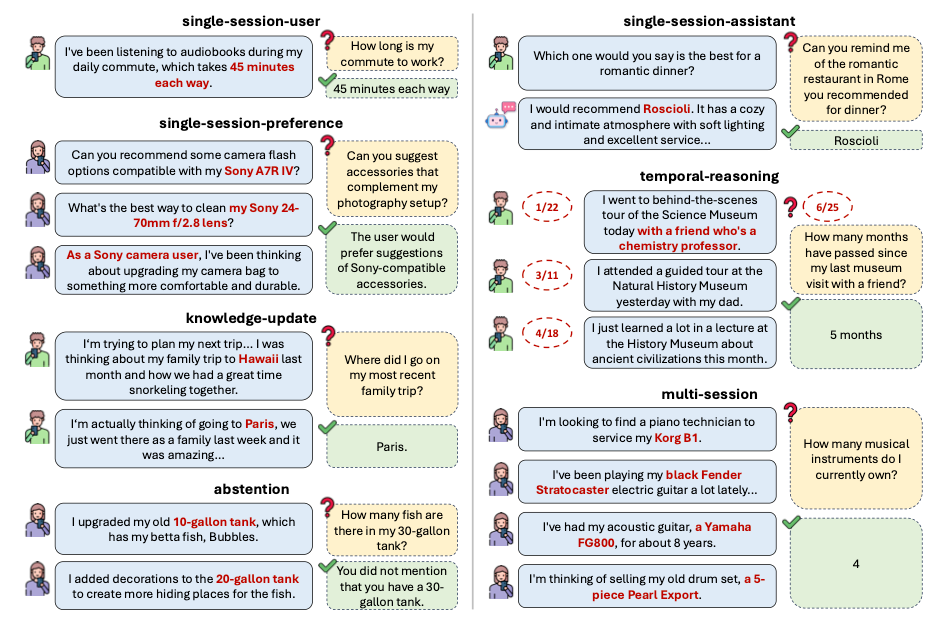 Five core long-term memory abilities (LongMemEval)
In 2024, the field changed tone.
The demos were no longer enough. Memory had to prove itself.
Two benchmarks mattered especially: LoCoMo and LongMemEval.
LoCoMo evaluated very long-term conversational memory across many sessions, with personas, temporal event graphs, and multimodal interactions. LongMemEval decomposed memory into abilities such as information extraction, multi-session reasoning, temporal reasoning, knowledge updates, and abstention.
This was a real paradigm shift. In 2023, memory papers showed what agents could do. In 2024, benchmarks showed how badly they still failed.
The other big shift was that RAG became one of the dominant ways people talked about memory. Retrieval was no longer just retrieval. It became long-term memory, especially when paired with graphs, summaries, or structured stores. HippoRAG made this connection explicit by drawing from hippocampal indexing theory. MemoRAG did something similar from another angle.
At the same time, model-integrated memory started to show up. Instead of only building stores around frozen models, papers explored parametric memory, explicit memory, episodic editing, and long-context event segmentation. The field reopened the question: should memory live outside the model, inside the model, or somewhere between the two?
This was the year memory stopped being just a patch for small context windows. By then, context windows were already much larger. The better argument became: even if you can stuff more into context, should you?
Memory was becoming not only more scalable than long context, but more structured, more selective, and potentially more meaningful.
2025: Memory Becomes a Product
By 2025, memory was no longer just a research prototype. It had become a product category.
Mem0, Zep, Letta, Supermemory, Cognee, and others were no longer merely discussing memory as an academic problem. They were packaging it as infrastructure. The pitch shifted from “we can remember” to “we can remember cheaply, quickly, and reliably enough for production.”
This is where the field became messier and more interesting.
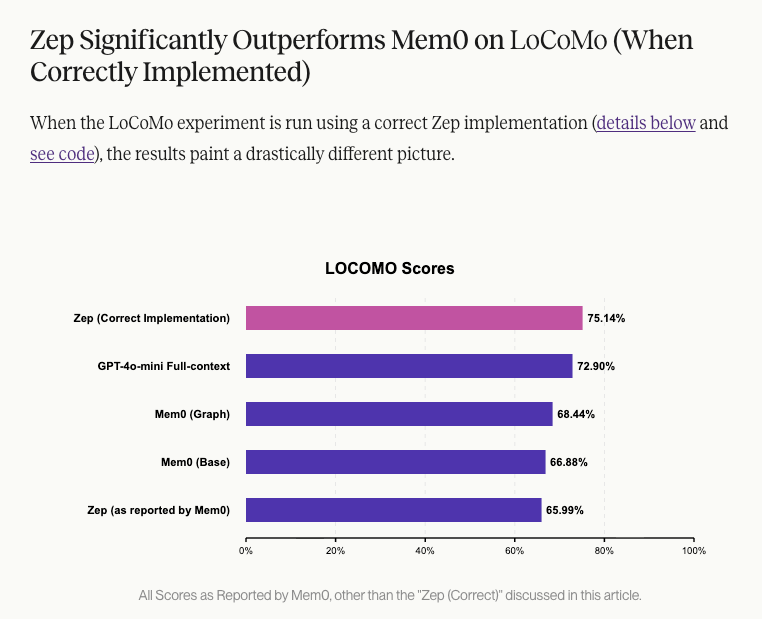
Benchmarks became marketing. LoCoMo scores turned into leaderboard claims. Vendors started disputing one another’s numbers. Zep published “Lies, Damn Lies & Statistics.” Mem0 and Letta became part of the debate around how memory should be evaluated. Supermemory published a parody post mocking the growing genre of benchmark victory laps.
That was funny, but it was also a warning. Once a benchmark becomes commercially valuable, people optimize for it. Sometimes that is progress. Sometimes it is Goodhart’s law with a better chart.
The substrate debate also became sharper. A lot of academic work leaned toward graphs, temporal knowledge graphs, and structured memory. But the product world started revealing a more pragmatic countercurrent: files, Markdown, search, compaction.
This is where Claude Code became an epiphany moment for me.
Claude Code did not win developers over by shipping an elaborate vector-memory system. It used the filesystem. It used search. It used grep. It navigated codebases with tools that looked almost embarrassingly simple compared with the memory architectures people were proposing.
I remember reading Charles Packer from Letta talking, even before Claude Code became the reference point it later became, about why vector search might not be the answer. I was skeptical. It felt too simple. Surely memory needed something more sophisticated.
Then Claude Code became one of the most successful agentic tools people actually used.
That changed how I thought about memory. Maybe “advanced memory” was not always about the most exotic substrate. Maybe the winning design, at least for coding agents, was the one that stayed legible: files, search, summaries, and a model capable enough to use them.
2026: The Benchmark Explosion
In 2026, the field seems to have realized that if the benchmarks are weak, everything built on top of them becomes unstable.
This is true for LLMs. It is true for agent harnesses. And it is true for memory.
Just in the first half of the year, we have seen a benchmark explosion: MemoryArena, AMA-Bench, LongMemEval-V2, StructMemEval, ImplicitMemBench, EvolMem, PERMA, MemoryCD, VehicleMemBench, MemoryRewardBench, and more.
But the important point is not the number of benchmarks. It is what they are trying to fix.
MemoryArena asks whether agents can acquire memory while acting in an environment, then use that memory to solve future tasks. That is different from recalling facts from a long conversation. It is closer to what agents actually need to do.
StructMemEval asks whether agents can organize memory into useful structures. ImplicitMemBench asks whether models show something like non-declarative memory: priming, adaptation, procedural behavior. PERMA and MemoryCD push toward personalization and preference evolution over time.
The field is basically saying: LoCoMo was necessary, but not sufficient.
A system can look good on conversational recall and still fail when memory has to support action, structure, updating, personalization, or implicit adaptation. This is the healthy kind of discomfort. It means the field is no longer satisfied with the first yardstick that worked.
At the same time, memory is becoming more autonomous. Papers now explore memory operations that are learned rather than hand-designed: when to create, read, update, delete, merge, forget, or promote a memory. Memory is moving from a passive store toward a policy.
That creates a new problem: if memory can rewrite itself, it can also corrupt itself.
So 2026 is also the year governance and safety become unavoidable. Persistent writable memory is an attack surface. It can leak information. It can preserve stale beliefs. It can let a bad summary poison future behavior. It can make a system confidently wrong for a long time.
Giving an agent memory is no longer the hard part. Giving it memory that can be trusted is.
The Industry Came Closer Than I Expected
On a personal note, this field also came closer to me than I expected.
Over the past year, people building in agent memory reached out to me, including Dhravya Shah from Supermemory, Sachit Mishra from YourMemory, Taranjeet Singh from Mem0, Sarah Wooders from Letta, Marc Pickett from Emergence AI, and Hande from Cognee.
I want to thank them for reaching out. I was slow to respond, partly because I had logged out of X and most social media for personal reasons, but I appreciated those conversations and signals more than I probably showed at the time.
I’m still watching this domain closely. Agent memory remains one of the topics I care about most, and I am still thinking about what kind of contribution I want to make to it.
Where I Think We Are
If I had to summarize the arc, I would put it this way:
2023 was invention.
2024 was measurement.
2025 was industrialization.
2026 is interrogation.
The early question was: can we make agents remember?
The current question is harder: can we make agents accumulate experience in a way that is measurable, economical, governable, and useful across time?
I find this field unusually exciting because it sits at the intersection of so many things: cognitive science, databases, operating systems, retrieval, personalization, safety, product design, and model training. It is messy in exactly the way young fields are messy. The metaphors are still fighting. The benchmarks are still unstable. The product claims are still too confident. The academic systems are often too expensive or too narrow. The practical tools sometimes look too simple to be taken seriously until they win.
But that is also why it feels alive.
Yann LeCun once compared progress in AI to stochastic gradient descent. I like that image for agent memory. From the outside, the field looks noisy. People overfit to benchmarks, pivot from graphs to files, rediscover old ideas from operating systems, borrow from neuroscience, ship products before the science is settled, then build new benchmarks to reveal what the products missed.
It can look random.
But maybe, over time, we are still converging.
We just do not know yet what the minimum will look like.
Originally published on Medium.