I used to think the bottleneck was execution.
For most of my life as an engineer, that felt obvious. If I had a good idea, the hard part was turning it into something real. You had to write the code, build the interface, debug the weird edge cases, deploy the thing, write the docs, fix the broken auth flow, rethink the data model, and then somehow still have enough energy left to tell people about it.
Then AI got good enough to do a lot of that.
And somehow, I became more anxious, not less.
This is not just my problem. I think a lot of people in tech feel some version of this right now, whether they are very senior builders, famous AI power users, or junior developers who just entered the industry at the worst and best possible time.
There is a new kind of tech anxiety in the air. It has many layers, but two of them feel especially common.
The first is what I half-jokingly call tokenmaxxing guilt.
You subscribe to Claude, Cursor, Codex, Devin, whatever agentic tool is fashionable this week. Suddenly, you have this strange feeling that unused tokens are wasted potential. If the model is not doing something, if there is no agent running, if no branch is being generated, if no side project is being pushed forward while you sleep, it feels like you are leaving money on the table.
Not money exactly. Something worse.
Possibility.
The second is the peer competition amplifier.
This anxiety already existed before AI. There was always someone on your timeline launching a new product, writing a beautiful essay, building a cool open-source project, getting acquired, raising money, publishing benchmarks, or casually posting screenshots of something that looks better than anything you have shipped in six months.
AI did not create this anxiety.
AI put it on steroids.
Now everyone seems to be building faster. Everyone seems to be shipping. Everyone seems to have a dozen agents working for them. Every week there is a new demo, a new repo, a new “built this over the weekend” post, a new reminder that maybe you are still standing in the same place while the rest of the world has quietly discovered a productivity cheat code.
I am not immune to this at all.
If anything, I am probably unusually vulnerable to it.
Since AI became capable of doing real autonomous work, I have used it to experiment with all kinds of things: memory systems, agent workflows, local model infrastructure, weird product ideas, automation scripts, writing tools, coding helpers, design prompts, and a long tail of half-formed things that made sense at 2 a.m. and became much harder to justify the next morning.
At first, it felt like a superpower.
Then I noticed something uncomfortable.
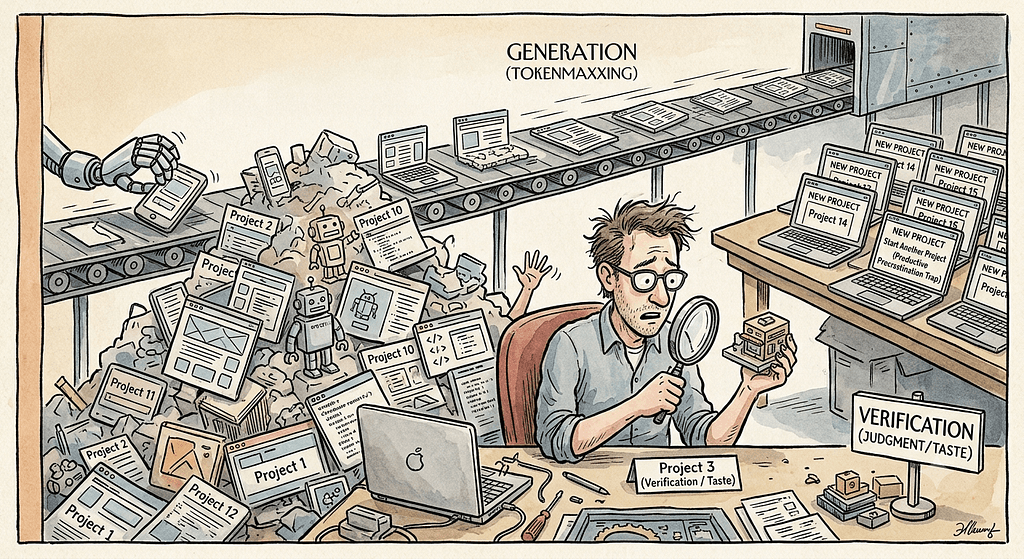
AI can generate work much faster than I can verify it.
And that changes everything.
AI scales generation, not verification
The current AI building meta often assumes that more automation means higher throughput.
This is true in a narrow sense. If the unit you are measuring is generated code, generated text, generated designs, generated PRs, or generated ideas, then yes, AI increases throughput dramatically.
But that is not the whole system.
The real system includes verification.
A model can produce a solution in seconds. But checking whether that solution is correct still takes human attention. Checking whether the architecture makes sense takes even more attention. Checking whether the feature belongs in the product at all takes taste. Checking whether the project is worth continuing takes something even heavier.
It takes judgment.
This is where the asymmetry appears:
AI scales generation. It does not scale verification.
At least not in the same way.
You can ask AI to review AI-generated code. You can ask one model to critique another model. You can build evals. You can run tests. You can create CI pipelines. You can automate parts of the review process.
All of that helps.
But at the end of the chain, some human still has to decide whether the thing is good, whether the direction is right, whether the abstraction is worth keeping, whether the output moves the project closer to something meaningful or merely adds more surface area.
This creates what I think of as verification hell.
Not because verification is impossible, but because the ratio is broken.
Before AI, if I wrote code for three hours, I had roughly three hours of context in my head. Reviewing it was not free, but at least the work and the understanding were coupled. The act of producing the thing also helped me understand the thing.
With AI, that coupling breaks.
The model can generate a thousand lines of code while I am drinking coffee. It can propose a new architecture before I have even fully reconstructed the old one in my head. It can create five plausible implementation paths, each with its own hidden assumptions and future maintenance costs.
The output is cheap.
Understanding the output is not.
And if you do not understand the output, you do not really own the work.
This is where AI productivity starts to become psychologically strange. You feel productive because the repo is changing. Branches are moving. Files are being created. PRs are appearing. The machine is doing work.
But your own mental model may not be improving at the same speed.
Sometimes it is even degrading.
You become the exhausted reviewer of a system you no longer fully understand.
The graveyard of AI side projects
There is a common escape route from verification hell: start another project.
This sounds irrational, but emotionally it makes perfect sense.
Reviewing AI output is cognitively expensive. It forces you to confront the possibility that the thing you generated is wrong, unnecessary, badly designed, or simply not worth finishing. It requires slow thought. It requires reloading context. It requires making decisions.
Starting a new project, on the other hand, feels clean.
The context is fresh. The possibilities are infinite. The model is excited. You are excited. There is no accumulated mess yet. No architecture debt. No unresolved product questions. No half-broken auth system. No embarrassing README that promises more than the repo can deliver.
So you open a new folder.
You ask the model to scaffold something.
For a moment, you feel productive again.
This is one of the most dangerous traps of AI-assisted building: AI does not only increase the speed of finished work. It also increases the speed of unfinished work.
Before AI, a side project had a natural friction. Even creating the first usable version required enough effort that you had to care a little. Now the cost of starting is so low that starting becomes a form of procrastination.
You can procrastinate by producing.
This is much harder to detect than ordinary procrastination, because from the outside it looks like work. You are writing prompts, reviewing diffs, choosing frameworks, deploying prototypes, generating UI, asking for refactors, building integrations. There is activity everywhere.
But activity is not completion.
And completion is not the same as value.
Over time, the side projects accumulate. Each one carries a tiny emotional debt. Each one is a reminder of a possible self who could have finished it. The anxiety does not go down, because the real bottleneck was never “not enough generated output.”
The bottleneck was closure.
Dense signals and sparse signals
Over the past few months, I have watched other people and watched myself. I noticed that the people who are best at turning tokens into real-world value, especially value measured by money, often share one trait:
They know what they are trying to do.
Not in some grand metaphysical sense. They just have a clear enough target.
They know the customer. They know the pain point. They know the workflow. They know the offer. They know what counts as success. They know what to ship next because the market gives them a dense feedback signal.
Does someone pay?
Does conversion improve?
Does retention move?
Does the support burden decrease?
Does the customer ask for it again?
This kind of feedback loop is extremely compatible with AI. If you have a clear target and a dense external signal, AI becomes a powerful cost reducer. It helps you test faster, ship faster, iterate faster, and close the loop faster.
This does not mean market-driven builders are shallow. In many ways, they are operating in a cleaner optimization environment. The objective function is noisy, but at least it exists.
The harder case is the meaning-driven builder.
This is the person who is not primarily motivated by money, or at least not only by money. They want to make something they personally recognize as valuable. Something that feels right. Something that expresses a taste, an intuition, an obsession, a standard.
This is where AI becomes much less straightforward.
Because the feedback signal is sparse.
You often know exactly what you do not like.
You know the existing tools feel wrong. You know the writing is not sharp enough. You know the interface has no soul. You know the abstraction is ugly. You know the product category is full of people optimizing the wrong thing. You know something is missing.
But knowing what you reject is not the same as knowing what you want.
And AI is much better at executing a clear positive specification than inferring an entire creative direction from dissatisfaction.
“I don’t like this” is not a dense enough training signal.
It may be emotionally true, but it is not enough to converge quickly.
This is why AI can feel strangely frustrating to people with high standards. The more you know, the higher your bar becomes. The higher your bar becomes, the harder it is for generated output to satisfy you. The more output you generate, the more you are forced to confront the gap between what exists and what you vaguely believe should exist.
That gap is not solved by more tokens.
Sometimes more tokens just make the gap more visible.
Taste is the real bottleneck
A lot of people talk about AI creativity as if creativity means generating ideas.
But in the AI era, ideas are not scarce.
Variants are not scarce. Drafts are not scarce. Names are not scarce. Mockups are not scarce. Boilerplate is not scarce. Even plausible strategies are not scarce.
What is scarce is knowing which idea has a soul.
Or, less romantically, knowing which direction is worth committing to.
This is taste.
Taste is not just preference. It is compressed judgment. It is the residue of everything you have read, built, admired, rejected, suffered through, and failed to explain. It is your internal model of what “good” feels like before you can fully justify it.
AI can imitate taste.
It can average taste.
It can remix the visible artifacts of taste.
But it cannot carry your taste for you.
This is why “AI is a great executor but a bad visionary” feels directionally true to me, at least for the kind of work I care about.
It can help pave the road very quickly once you give it coordinates.
But if you do not know where you want to go, it will happily generate roads in every direction.
That is not freedom.
That is a maze.
I do not think AI is useless for creativity. Quite the opposite. Some of my best ideas recently have come from conversations with AI. There is something genuinely strange and valuable about talking to this ghost made from the statistical residue of human civilization.
It can reflect ideas back at you. It can combine frames you would not have combined. It can push back. It can ask questions. It can help turn vague discomfort into clearer language.
But that process is not the same as generation.
It is slower. More dialogical. More human.
The value is not that AI gives you the answer.
The value is that it helps you hear yourself think.
In that sense, the best creative use of AI may not be outsourcing imagination. It may be densifying your own signal.
Instead of asking:
“Build me something great.”
The better questions are:
“Why do I keep rejecting these versions?”
“What exactly feels wrong here?”
“What value am I trying to protect?”
“What would have to be true for me to be proud of this?”
“What am I pretending is a product problem when it is actually a taste problem?”
AI cannot answer these questions for you in any final sense.
But it can keep you in conversation long enough for your own answer to become less vague.
That is valuable.
It is just not infinitely scalable.
Information is not understanding
The same confusion appears in how we talk about learning with AI.
When LLMs first became useful, one of my immediate reactions was that even with AI, we probably would not be able to learn much faster.
At least not in the way people hoped.
If a book takes three hours to read, maybe it still takes three hours to read.
Not because summarization is useless, but because the thinking that happens during reading is part of the learning.
The friction is not a bug.
It is the mechanism.
I remember reading How to Read a Book in high school, or at least encountering its central distinction around that time: reading for information versus reading for understanding.
That distinction feels even more important now.
If your goal is to get information, AI summaries are incredible. They compress. They extract. They give you the gist. They help you decide whether something is worth reading in full. They reduce the cost of scanning the world.
But understanding is different.
Understanding is not just having the right bullet points in your notes. It is not just knowing what the author said. It is not even just being able to repeat the argument.
Understanding means the structure of your thinking has changed.
You have a new distinction. A new lens. A new suspicion. A new standard. A new way of noticing. Something in you has been rearranged.
A summary cannot do that for you.
It can give you the map, but it cannot walk the terrain on your behalf.
This is why I am skeptical of the idea that AI summaries will magically make us wiser. They will make us better informed. That is useful. But information and understanding are different goods.
The better use of AI for learning is probably not:
“Summarize this so I do not have to think.”
It is more like:
“I read this and something bothered me. Help me figure out why.”
You read something. You argue with it. You bring your confusion to the model. You ask it to restate your position. You ask it to challenge you. You explain why a paragraph bothers you. You connect it to your own experience. You write a reflection. You notice what changed in your mind.
In this mode, AI is not a shortcut around thought.
It is a medium for thought.
That difference matters.
Because the bottleneck is still you.
Your attention. Your memory. Your emotional honesty. Your willingness to be changed by what you read. Your ability to sit with ambiguity instead of immediately converting everything into output.
AI can help create better conditions for understanding.
It cannot internalize knowledge on your behalf.
Unless we become true cyborgs, maybe this bottleneck never fully goes away.
And maybe that is okay.
Carbon growth in the age of silicon speed
Compared to silicon, carbon-based life is not impressive because of speed.
We are slow. We get tired. We need sleep. We forget things. Our motivation fluctuates. Our working memory is tiny. Our attention is fragile. We cannot run 24 hours a day. Even when we technically have time, we may not have the mental energy to review, decide, or care.
AI makes this painfully obvious.
The machine can keep going.
We cannot.
But maybe the point was never to compete with the machine on speed.
Maybe the human role in the AI era is not to be a slower generator, but to be the sense-maker.
The person who decides what matters.
The person who develops taste.
The person who notices when a project is technically successful but spiritually empty.
The person who can say: this is clever, but not worth doing.
That last skill may become more important than we realize.
In a world where generation is cheap, refusal becomes expensive.
Knowing what not to do becomes a serious advantage.
This is deeply unintuitive, because the entire AI productivity narrative pushes us in the opposite direction. More output. More automation. More agents. More workflows. More leverage. More tokens. More everything.
And to be clear, I like productivity. I like automation. I like building tools. I am not making an anti-AI argument. I use these systems every day, probably too much.
But I think we need to be honest about the psychological trap.
Using more tokens does not necessarily create more value.
Generating more artifacts does not necessarily create more progress.
Starting more projects does not necessarily make you more ambitious.
Reading more summaries does not necessarily make you wiser.
Shipping faster does not necessarily mean you are moving in the right direction.
The market will continue to reward visible throughput because visible throughput is easy to measure. AI companies will continue to sell efficiency because efficiency is easy to explain. Managers will continue to ask how much productivity improved. Investors will continue to look for graphs that go up.
But much of the work that actually matters is invisible.
Forming judgment is invisible.
Developing taste is invisible.
Changing your mind is invisible.
Learning what you truly care about is invisible.
Deciding to finish one meaningful thing instead of starting ten plausible things is invisible.
And because these things are hard to measure, they will be undervalued for a while.
Maybe for a long while.
Still, I suspect this is where the real work is.
The antidote to AI anxiety is not to maximize token usage. It is not to keep every model busy. It is not to match the timeline’s apparent shipping velocity. It is not to turn yourself into a project-starting machine.
The antidote is to reclaim your pace of thought.
To accept that meaningful things take time.
To use AI not only as an executor, but as a mirror, a critic, a sparring partner, and occasionally a lantern.
To finish fewer things, but choose them more carefully.
To remember that the scarce resource was never tokens.
It was attention.
It was judgment.
It was taste.
It was the ability to decide what deserves to exist.
AI made execution cheap.
That made judgment more expensive than ever.
Originally published on Medium.