
The revolution in Large Language Models (LLMs) is undeniable, but their stateless nature remains a significant hurdle. Like Dory from Finding Nemo, they often forget the context of previous interactions, limiting their ability to engage in truly personalized, long-running conversations or tasks. This is where AI Memory layers come in — dedicated systems designed to give our AI applications persistent, searchable context.
The space is heating up, with several interesting players emerging. Today, we’ll compare three prominent solutions: the community-driven Letta, the production-focused Mem0, and the research-led Zep.
A quick note: I previously wrote an article diving deep into Mem0’s capabilities (The AI Memory Challenge, Part 1: We Asked Mem0 to Remember Five Things). You might wonder why there isn’t a Part 2 comparing Letta and Zep using the same benchmarks. Frankly, based on my evaluation, neither Letta nor Zep feels quite ready for that kind of production-oriented stress test just yet. This post, therefore, focuses on a higher-level comparison of their current state, philosophy, and potential.
We’ll look at them through lenses like maturity, openness, developer experience, and core approach.
Letta: The Community-Driven Open Source Hope
Letta stands out for its commitment to being truly open source (compared to the other two; more on this later). It aims to be incredibly user-friendly, working out of the box with good documentation to get you started. They initially experimented with a cloud-based Agent Development Environment (ADE) but have since wisely removed that requirement and even built a helpful Desktop UI.
Strengths:
- Genuinely Open & Accessible: It just works. The documentation is solid for initial setup, and the Desktop app lowers the barrier to entry significantly.
Vibrant Community: This is Letta’s superpower. Their Discord channel is buzzing with activity. Have a question? Jump in, and chances are someone knowledgeable (often core contributors like cpakcer or swooders) will help you out quickly. I experienced this firsthand — after writing an article about setting up Letta with Supabase a few weeks ago (Setting up Letta (MemGPT) with Supabase), the team enthusiastically engaged, liked my posts, and even connected on X. That level of community interaction is fantastic.
Challenges:
- Not Yet Production Ready: Despite the progress, Letta isn’t quite there for mission-critical applications. I’ve been eagerly awaiting their SaaS offering for my own project, but it’s still under development. While their “build in public” strategy is admirable for transparency, it does mean timelines can stretch.
- Agentic Nature & LLM Dependency: Unlike the others, Letta leans towards being an agentic framework. This means its overall effectiveness heavily depends on the inherent “intelligence” and reasoning capabilities of the specific LLM used. While this approach could be powerful with future, more advanced models, it can feel ambitious today, as current LLMs might not yet be consistently capable enough to drive the complex behaviors Letta aims to enable, potentially limiting its practical performance compared to more constrained memory approaches.
- Focus Allocation?: While the Desktop app and broad support for different models/databases are great for accessibility, I sometimes worry if resources might be spread a bit thin. The core memory functionalities could benefit from more focused development to become truly robust for complex scenarios.
Mem0: The Production-Ready SaaS Play
Backed by Y Combinator, Mem0 positions itself as the most mature and production-ready memory solution currently available, particularly via its SaaS offering.
Strengths:
- Relative Reliability: Compared to the others, Mem0’s SaaS platform feels the most stable and ready for real-world use. If you need something now, it’s likely your best bet.
- Simple Integration & Ops: Their API design is straightforward, making integration relatively painless. The SaaS platform also provides a useful dashboard for monitoring memory usage and understanding agent behavior. Documentation for the API is decent.
Challenges:
- “Open Source” with Caveats: While the core is Apache 2.0 licensed, it’s clear the focus is on the SaaS product. Documentation for self-hosting is sparse, and based on community reports and the lack of dedicated support, getting a reliable self-hosted instance running seems challenging. They aren’t actively making it easy.
- Pricing & Trial Limitations: The free credits offered for evaluating the SaaS platform are quite limited, making it hard to thoroughly assess if it meets your project’s needs before committing. The pricing can also be steep, especially for smaller teams or indie developers. While they recently introduced a $19/month Starter tier, the jump to the $249/month Pro plan is significant, and even the starter tier might feel pricey for early-stage projects.
Zep: The Research-Focused Deep Dive
Zep takes a more academic and research-driven approach to the AI memory problem. They emphasize technical sophistication and performance benchmarks.
Strengths:
- Technical Depth & Transparency: Zep published a paper comparing their performance against others (including Letta) on benchmarks like LongMemEval and DMR. While the paper itself has flaws (more on that below), it signals an intent to engage with formal evaluation. They’ve also open-sourced core algorithms under the project graphiti (Apache 2.0), claiming these power their SaaS.
- Insightful Content: Zep maintains an excellent technical blog — arguably the best among the three. They dive deep into the engineering challenges of building memory systems, offering genuinely insightful posts that are great for learning.
- Sophisticated Approach: Reading their materials, it feels like Zep has put significant thought into the hard problems of AI memory, aiming for more advanced techniques than simple vector recall.
Challenges:
- The “Paper”: Honestly, Zep’s paper is one of the most pretentious and least informative “academic” documents I’ve encountered. It reads like a superficial marketing piece disguised with equations, vaguely gesturing at solutions without real substance (think GPT-4’s technical report). The mathematical notation often feels forced and almost comical. It tries too hard to look rigorous while revealing very little.
- graphiti Isn't Plug-and-Play: While open-sourcing core algorithms is commendable, graphiti by itself isn't a ready-to-use memory system. You'd need significant effort to build a functional solution around it.
- Immature SaaS: Judging from the free tier experience, Zep’s SaaS offering is currently far from polished or reliable. It feels very much under development, likely prioritizing large enterprise clients over immediate usability for smaller users. Don’t expect it to work smoothly out of the box yet.
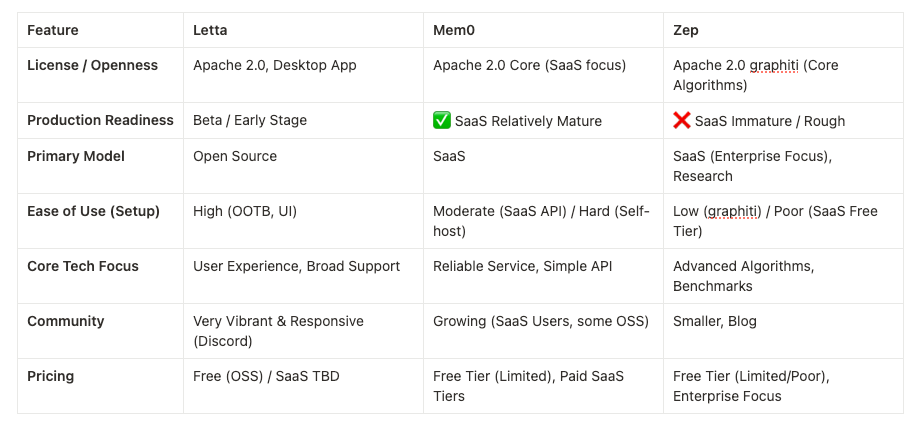 Side-by-Side Comparison
Recommendations: Which Memory Layer Fits Your Needs?
- Go with Letta if: You prioritize true open source, love engaging with an active community, aren’t on a tight production deadline, and are happy to grow alongside the project. It’s the enthusiast’s choice.
- Go with Mem0 if: You need a functional AI memory solution right now, prefer a managed SaaS offering, and have the budget for their plans. Be prepared to rely on their cloud service, as self-hosting seems like a secondary concern for them. Crucially, test it thoroughly yourself to ensure it meets your specific reliability and performance needs.
- Look into Zep if: Your primary goal is to learn about the cutting edge of AI memory systems. Read their blog, dig into the graphiti code, and critically analyze their paper (perhaps with a chuckle). It’s a valuable resource for understanding advanced concepts, even if their product isn’t ready for prime time deployment yet.
Conclusion
The AI memory layer space is dynamic and crucial for unlocking the next level of AI application capabilities. Letta, Mem0, and Zep represent three distinct philosophies: community-led open source, pragmatic SaaS, and research-driven sophistication.
Your choice today depends heavily on your timeline, budget, tolerance for rough edges, and whether you prioritize immediate deployment, open ecosystems, or learning advanced techniques. Keep an eye on all three — the landscape is evolving rapidly, and the best solution for you might change in the coming months.
Originally published on Medium.